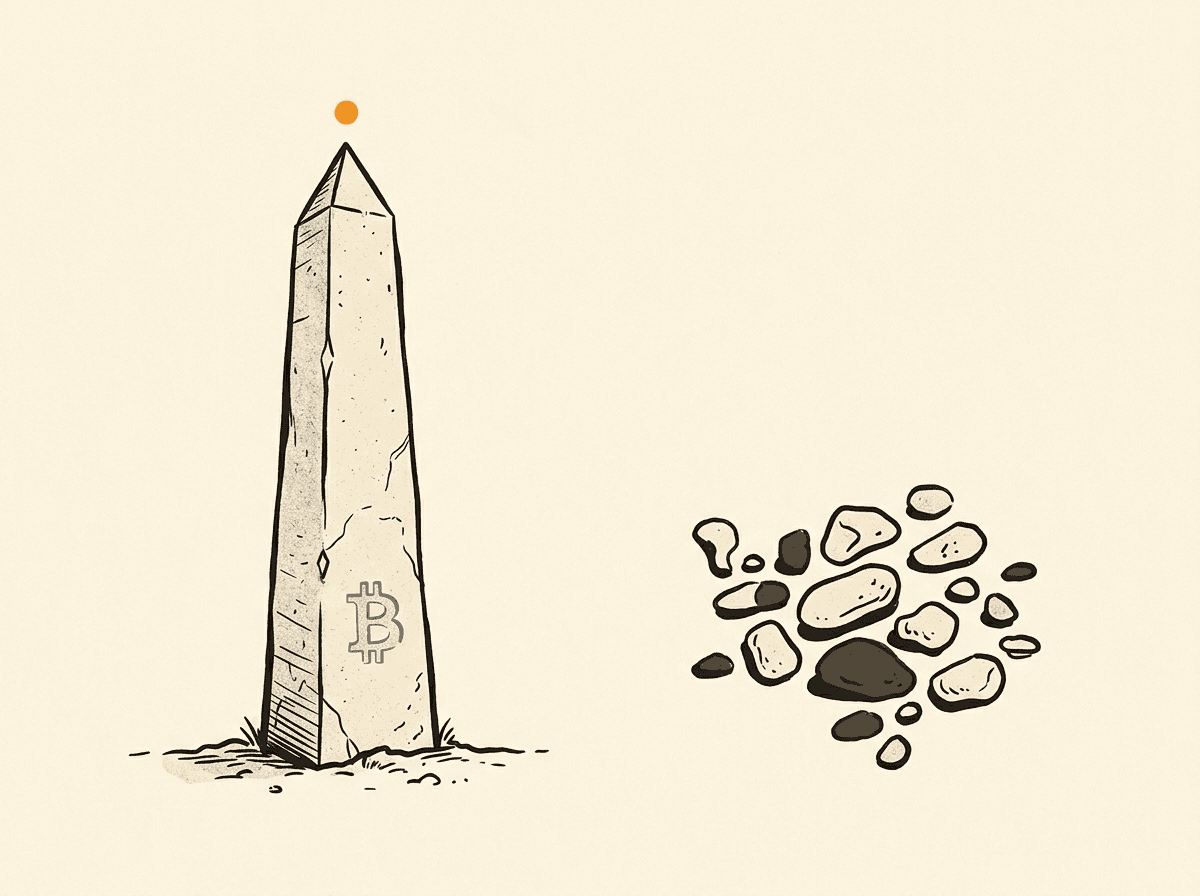

I get a specific kind of frustration when someone tells me they’re “getting into crypto” and then asks me which coins they should buy alongside Bitcoin. I used to answer charitably and try to explain my thinking. These days I still answer charitably, but I start with a question: do you think of these things as the same category? Because I don’t.
This guide explains why I draw a hard line between Bitcoin and what gets called “crypto.” It’s not because I’m tribal, though I’ve been accused of that. It’s because the monetary and technical properties differ in ways that matter enormously when you’re deciding whether something is a form of money worth holding versus a speculation on a software project. I’ve been a Bitcoiner since 2017, I run a full node at home, and I’ve had this conversation enough times that I want to write it down properly.
Why this post exists
In early 2021, a close friend who trusts my technical judgment called me to ask about a project that had been getting attention on social media. He described it as “like Bitcoin but faster and cheaper.” I listened to his description and asked him a few questions: Who controls the validator set? Can the founders change the supply? Is there a foundation with significant holdings? The answers were: a small committee, yes under certain conditions, and yes respectively. I told him that’s a fundamentally different thing from Bitcoin. He bought it anyway, made money for a few months, and then watched it collapse.
I’m not telling that story to say I told you so. I’m telling it because those three questions — who controls it, can the supply change, who holds significant amounts — are the right questions to ask. And Bitcoin’s answers are categorically different from most things lumped under “crypto.”
The word “crypto” is doing too much work. It gets applied to Bitcoin, to stablecoins pegged to the dollar, to governance tokens for DeFi protocols, to NFT projects, to algorithmic experiments in monetary policy, to loyalty point systems dressed up with blockchain branding. These are not the same thing. Treating them as a category called “crypto” is like treating savings accounts, lottery tickets, venture capital investments, and government bonds as a category called “finance” and assuming they behave similarly.
The monetary test: scarcity, issuance, and ownership
Money has properties. The most important ones for evaluating a monetary asset are scarcity (is there a fixed or predictable supply?), issuance (who decides how much gets created?), and ownership (can you actually hold it without counterparty risk?).
Bitcoin passes all three with unusual strength.
Scarcity
Bitcoin’s total supply is capped at 21 million coins. This isn’t a policy or a corporate decision — it’s enforced by every one of the tens of thousands of nodes running the protocol. When I run my node at home and validate blocks, my software rejects any block that claims a coinbase reward exceeding the current schedule. The schedule is: 50 BTC per block from genesis, halving every 210,000 blocks, continuing until the last fraction of a sat is mined around the year 2140.
I can audit this right now. I can look at the Bitcoin Core source code and read the exact function that calculates the subsidy. No one can call me on the phone and convince me the supply changed — my node tells me. This is what “don’t trust, verify” means in practice.
Most other assets in the “crypto” space have supply schedules controlled by foundations, by governance votes, by multisig committees, or by code that can be upgraded by small groups. “Fixed supply” in those contexts often means “fixed until we vote to change it.” That’s a different thing.
Issuance
New bitcoin is issued only through mining — the proof-of-work process where machines compete to produce valid blocks. The issuance rate is entirely predictable and follows the halving schedule. Nobody can issue more. There is no emergency lever. There is no “monetary policy committee” that meets to decide whether to increase the money supply.
Halvings are worth understanding in concrete terms. In 2009, each block produced 50 BTC. In 2012, it halved to 25. In 2016, to 12.5. In 2020, to 6.25. In 2024, to 3.125. This schedule is known, public, and has operated exactly as specified for over 16 years.
Compare this to any monetary system where a governing body can decide to increase issuance. Even if the stated policy is conservative, the ability to change it is itself a risk. Bitcoin removes that ability.
Ownership
Bitcoin you hold in self-custody is truly yours. There’s no custodian, no issuer, no entity that can freeze it, reverse the transaction, or confiscate it without your private key. I keep my bitcoin in a multisig setup with keys in different physical locations. Short of actual coercion — the famous “$5 wrench attack” — no remote actor can touch those funds.
Many “crypto” assets have admin keys, pause mechanisms, blacklists, or upgrade proxies that allow developers to modify balances. These are useful features for software systems. They are antithetical to sound money. If someone with admin privileges can freeze your balance, you have a counterparty risk that looks indistinguishable from a bank account.
The security test: proof-of-work, node count, and ossification
Beyond monetary properties, I evaluate any would-be monetary network on its security model. Bitcoin’s is unusually robust. Let me explain why I think that.
Proof-of-work
Bitcoin uses proof-of-work (PoW) to achieve consensus. Miners expend real energy to produce valid blocks. This expenditure is not wasted — it’s what makes rewriting history astronomically expensive. To rewrite Bitcoin’s recent blocks, an attacker would need to control more hash power than the entire rest of the network combined and then outpace it going forward. At Bitcoin’s current hash rate, this is an amount of hardware and electricity that no single nation-state could easily assemble without being noticed.
I know proof-of-work gets criticized for energy use. I’ve thought about this a lot. The energy is the security. A monetary network that secures tens of trillions of dollars in value needs robust Sybil resistance — a way to make it expensive to fake participation. PoW is the only mechanism that has proven itself at scale over 16+ years.
Alternative consensus mechanisms shift trust rather than eliminating it. When security depends on validators who can be identified, pressured, or who hold large stakes that align their interests with particular outcomes, the security model is different — and in my assessment, weaker for monetary use cases where censorship-resistance matters most.
Node count and decentralization
Bitcoin currently has over 20,000 reachable full nodes, with the true count of all validating nodes (including those behind NAT or Tor) estimated much higher. Each node independently validates every transaction and block. No node is in a privileged position — my node at home has exactly the same rule-enforcement power as a node run by a major exchange or a mining pool.
Decentralization in practice means that capturing or coercing any subset of nodes does not give you control over the protocol. An attacker who compromises 1,000 nodes still faces the other 19,000+. This is what network-level censorship-resistance looks like.
I pay attention to node counts and geographic distribution when thinking about network resilience. A network with 50 nodes run by a handful of entities in two countries is not decentralized in any meaningful sense, regardless of the technical architecture.
Ossification
Bitcoin’s protocol changes very slowly, and I think this is a feature. The protocol has been running since January 2009. The core data structures, the transaction format, the 21-million cap — these have been stable for years. Soft forks that add capabilities (like Segwit, which improved transaction efficiency and enabled the Lightning Network) require extended consensus processes. Hard forks require opt-in from essentially all participants.
This conservatism frustrates people who want rapid feature development. For a monetary base layer, I think it’s correct. I don’t want my savings in a protocol that ships breaking changes on a quarterly roadmap. Stable rules are a prerequisite for long-term trust.
The founder problem
Bitcoin’s pseudonymous creator, Satoshi Nakamoto, disappeared in 2010 after handing off the project to the development community. Nobody has ever produced cryptographic proof of Satoshi’s identity. The early bitcoin addresses associated with Satoshi — estimated to hold around 1 million BTC — have never moved.
This is unusual to the point of being unique. The absence of a known, living founder means there is no individual who can be pressured by governments, who can sell a large stake for personal gain, who can make authoritative pronouncements about what the protocol “really means” or “is supposed to do,” or who can be compelled to implement backdoors.
I’m not saying Satoshi’s disappearance was planned or altruistic — I genuinely don’t know. What I’m saying is that the result, whatever the cause, is a protocol that has no identified founder who can exert influence over it. That property is extraordinarily rare and, for a monetary system, extraordinarily valuable.
Most projects in the “crypto” space have known founders with significant holdings, active social media presence, and ongoing technical leadership. This isn’t inherently bad for a software project. It is incompatible with the properties I look for in sound money.
The culture test
People who hold Bitcoin the way I do often get called “maximalists” or “toxic” by the broader crypto community. I want to examine this honestly because I think the criticism sometimes has merit and sometimes doesn’t.
The legitimate version of the criticism: Bitcoin culture can be dismissive and unwelcoming to newcomers. Some Bitcoin Twitter behavior — aggressive mockery of altcoins, reflexive hostility to any change — is counterproductive and unpleasant. I don’t think that’s the right way to engage and I try not to engage that way.
The less legitimate version: the “toxic” label gets applied to any clear statement of Bitcoin’s properties relative to other projects. If I say “most ‘crypto’ projects have mutable supply schedules controlled by small groups” and someone calls that toxic, I think they’re using “toxic” as a rhetorical move to avoid engaging with the substance.
I’ll make a distinction that I think is important: skepticism of claims made by projects is healthy, and making that skepticism explicit is not hostility. When I evaluate a project against the monetary properties I’ve described above, I’m doing the same thing a careful investor does with any asset. “Don’t trust, verify” applies here too.
The culture I genuinely value in the Bitcoin community is its commitment to evidence over authority. When someone makes a claim about Bitcoin — about its supply, its security, its transaction throughput — the correct response is to check it against the protocol, the node counts, the chain data. Not to trust a white paper, not to trust a CEO, not to trust me. Verify.
What I check before any BTC-adjacent claim
Over the years I’ve developed a set of questions I run through when I encounter a claim about Bitcoin or about any “crypto” project. I share them here as a heuristic, not as investment advice.
For supply claims:
- Can I verify the total issuance from a block explorer?
- Is the issuance schedule encoded in the protocol, or is it a policy that can be changed?
- Who has the technical ability to change the supply rules, and how hard is it?
For security claims:
- What is the consensus mechanism? How expensive is a reorg attack?
- How many independent nodes are validating the chain?
- Where are those nodes geographically and legally located?
For decentralization claims:
- Is there a foundation or company that controls significant protocol decisions?
- Are the core developers compensated by a single entity?
- Who controls the domain names, the communication channels, the upgrade process?
For ownership claims:
- Can the asset be frozen by the issuer or a third party?
- Are there admin keys, pause mechanisms, or upgrade proxies?
- Does “self-custody” work the same way it does for Bitcoin, or is there a dependency on a smart contract or issuer?
For identity claims:
- Who founded the project and what is their current stake and role?
- Are founders’ holdings locked, unlocked, or unknown?
Bitcoin passes all these tests in ways that I find unique. That doesn’t mean Bitcoin is perfect or that its price will do anything in particular. It means that when I think about monetary properties specifically, Bitcoin stands alone in the landscape I’ve evaluated.
Where to go from here
If you’ve read this and want to go deeper into Bitcoin’s properties, here’s where I’d send you:
- What is Bitcoin? — if you want the foundational primer on how Bitcoin actually works
- How to buy your first sats — practical guide to acquiring Bitcoin once you’ve decided it’s what you want
- Self-custody basics — because understanding the distinction matters most when you’re deciding where to hold your savings
The inflation-vs-btc tool on this site lets you model what fixed-supply money looks like against fiat inflation over time — a useful concrete illustration of the supply argument.
Related tools
- Inflation vs BTC Calculator — visualize how fiat purchasing power erodes versus bitcoin’s fixed supply
Further reading
- Bitcoin: A Peer-to-Peer Electronic Cash System — Satoshi Nakamoto’s whitepaper; 9 pages that describe the entire system
- Mastering Bitcoin — Andreas M. Antonopoulos; the definitive technical reference on how Bitcoin works
- The Bitcoin Standard — Saifedean Ammous; makes the case for Bitcoin as sound money from first principles
- Bitcoin Wiki: Controlled Supply — technical documentation on Bitcoin’s supply schedule
- Bitcoin Node Count — live count of reachable Bitcoin nodes worldwide; I check this periodically